

How To Draw Adamantane In Chemdraw
 | |
 | |
 | |
| Names | |
|---|---|
| Preferred IUPAC proper name Adamantane[1] | |
| Systematic IUPAC name Tricyclo[3.3.1.anethree,vii]decane | |
| Identifiers | |
| CAS Number |
|
| 3D model (JSmol) |
|
| Beilstein Reference | 1901173 |
| ChEBI |
|
| ChEMBL |
|
| ChemSpider |
|
| DrugBank |
|
| ECHA InfoCard | 100.005.457 |
| EC Number |
|
| Gmelin Reference | 26963 |
| PubChem CID |
|
| UNII |
|
| CompTox Dashboard (EPA) |
|
| InChI
| |
| SMILES
| |
| Properties | |
| Chemical formula | C 10 H 16 |
| Molar mass | 136.238 chiliad·mol−1 |
| Appearance | White to off-white powder |
| Density | 1.08 g/cm3 (twenty °C),[2] solid |
| Melting point | 270 °C (518 °F; 543 One thousand) sealed tube |
| Boiling point | Sublimes |
| Solubility in water | Poorly soluble |
| Solubility in other solvents | Soluble in hydrocarbons |
| Refractive index (n D) | 1.568[3] |
| Structure | |
| Crystal construction | cubic, space group Fm3m |
| Coordination geometry | 4 |
| Dipole moment | 0 D |
| Hazards | |
| Occupational rubber and health (OHS/OSH): | |
| Main hazards | Combustible |
| GHS labelling: | |
| Pictograms |   |
| Signal word | Warning |
| Risk statements | H319, H400 |
| Precautionary statements | P264, P273, P280, P305+P351+P338, P337+P313, P391, P501 |
| Related compounds | |
| Related compounds: | Memantine Rimantadine Amantadine |
| Except where otherwise noted, data are given for materials in their standard state (at 25 °C [77 °F], 100 kPa). | |
 Nverify (what is Nverify (what is  Y Y  N ?) N ?) | |
| Infobox references | |

Adamantane is an organic compound with a formula C10H16 or, more descriptively, (CH)4(CH2)half-dozen. Adamantane molecules can be described as the fusion of three cyclohexane rings. The molecule is both rigid and well-nigh stress-free. Adamantane is the virtually stable isomer of CxH16. The spatial arrangement of carbon atoms in the adamantane molecule is the aforementioned as in the diamond crystal. This similarity led to the proper name adamantane, which is derived from the Greek adamantinos (relating to steel or diamond).[4] It is a white solid with a camphor-like smell. It is the simplest diamondoid.
The discovery of adamantane in petroleum in 1933 launched a new field of chemistry defended to the synthesis and properties of polyhedral organic compounds. Adamantane derivatives take constitute practical application equally drugs, polymeric materials, and thermally stable lubricants.
History and synthesis [edit]
In 1924, H. Decker suggested the existence of adamantane, which he called decaterpene.[v]
The get-go attempted laboratory synthesis was made in 1924 by German language chemist Hans Meerwein using the reaction of formaldehyde with diethyl malonate in the presence of piperidine. Instead of adamantane, Meerwein obtained 1,3,5,vii-tetracarbomethoxybicyclo[3.3.i]nonane-2,half-dozen-dione: this chemical compound, subsequently named Meerwein's ester, was used in the synthesis of adamantane and its derivatives.[6] D. Bottger tried to obtain adamantane using Meerwein'due south ester as forerunner. The production, tricyclo-[3.3.1.13,7], was not adamantane, but a derivative.[7]
Other researchers attempted to synthesize adamantane using phloroglucinol and derivatives of cyclohexanone, but besides failed.[8]
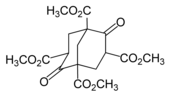
Adamantane was first synthesized by Vladimir Prelog in 1941 from Meerwein'south ester.[9] [10] With a yield of 0.xvi%, the five-phase process was impractical (simplified in the paradigm beneath). The method is used to synthesize certain derivatives of adamantane.[8]

Prelog's method was refined in 1956. The decarboxylation yield was increased by the add-on of the Heinsdecker pathway (xi%) and the Hoffman reaction (24%) that raised the total yield to 6.5%.[eleven] [12] The process was withal too complex, and a more convenient method was found in 1957 by Paul von Ragué Schleyer: dicyclopentadiene was first hydrogenated in the presence of a catalyst (e.g. platinum dioxide) and then transformed into adamantane using a Lewis acid (e.g. aluminium chloride) as another goad. This method increased the yield to xxx–forty% and provided an affordable source of adamantane; it therefore stimulated label of adamantane and is however used in laboratory practice.[13] [xiv] The adamantane synthesis yield was afterwards increased to threescore%[fifteen] and 98% past ultrasound and super acid catalysts. Today, adamantane is an affordable chemical compound with a cost of most $i a gram.

All the above methods yield adamantane every bit a polycrystalline pulverization. Using this powder, single crystals tin can be grown from the melt, solution, or vapor phase (due east.g. with the Bridgman–Stockbarger technique). Cook growth results in the worst crystalline quality with a mosaic spread in the X-ray reflection of virtually one°. The best crystals are obtained from the liquid phase, but the growth is impracticably slow – several months for a five–ten mm crystal. Growth from the vapor phase is a reasonable compromise in terms of speed and quality.[2] Adamantane is sublimed in a quartz tube placed in a furnace, which is equipped with several heaters maintaining a sure temperature gradient (nigh 10 °C/cm for adamantane) forth the tube. Crystallization starts at one finish of the tube, which is kept nigh the freezing point of adamantane. Slow cooling of the tube, while maintaining the temperature gradient, gradually shifts the melting zone (rate ~2 mm/60 minutes) producing a unmarried-crystal boule.[16]
Natural occurrence [edit]
Adamantane was kickoff isolated from petroleum by the Czech chemists S. Landa, V. Machacek, and Grand. Mzourek.[17] [18] They used fractional distillation of petroleum based. Landa et al. could produce only a few milligrams of adamantane, only noticed its high boiling and melting points. Because of the (assumed) similarity of its structure to that of diamond, the new compound was named adamantane.[8]
Petroleum remains a source of adamantane; the content varies from between 0.0001% and 0.03% depending on the oil field and is likewise low for commercial product.[19] [20]
Petroleum contains more than thirty of derivatives of adamantane.[19] Their isolation from a circuitous mixture of hydrocarbons is possible due to their high melting point and the ability to dribble with water vapor and form stable adducts with thiourea.
Physical backdrop [edit]
Pure adamantane is a colorless, crystalline solid with a characteristic camphor smell. It is practically insoluble in h2o, but readily soluble in nonpolar organic solvents.[21] Adamantane has an unusually high melting indicate for a hydrocarbon. At 270 °C, its melting point is much higher than other hydrocarbons with the same molecular weight, such as camphene (45 °C), limonene (−74 °C), ocimene (50 °C), terpinene (lx °C) or twistane (164 °C), or than a linear C10H22 hydrocarbon decane (−28 °C). Still, adamantane slowly sublimes fifty-fifty at room temperature.[22] Adamantane can be distilled with h2o vapor.[xx]
Construction [edit]

Bond lengths and angles of adamantane.
As deduced by electron diffraction and X-ray crystallography, the molecule has Td symmetry. The carbon–carbon bond lengths are 1.54 Å, most identical to that of diamond. The carbon–hydrogen distances are one.112 Å.[three]
At ambient conditions, adamantane crystallizes in a face-centered cubic structure (space grouping Fm3m, a = ix.426 ± 0.008 Å, four molecules in the unit cell) containing orientationally disordered adamantane molecules. This construction transforms into an ordered, primitive, tetragonal phase (a = vi.641 Å, c = 8.875 Å) with two molecules per cell, either upon cooling to 208 K or pressurizing to above 0.5 GPa.[viii] [22]
This phase transition is of the kickoff order; it is accompanied past an anomaly in the oestrus capacity, elastic, and other backdrop. In detail, whereas adamantane molecules freely rotate in the cubic stage, they are frozen in the tetragonal one; the density increases stepwise from 1.08 to 1.eighteen g/cm3 and the entropy changes by a significant amount of 1594 J/(mol·K).[2]
Hardness [edit]
Elastic constants of adamantane were measured using large (centimeter-sized) single crystals and the ultrasonic echo technique. The principal value of the elasticity tensor, C11, was deduced equally 7.52, 8.twenty, and vi.17 GPa for the <110>, <111>, and <100> crystalline directions.[16] For comparison, the corresponding values for crystalline diamond are 1161, 1174, and 1123 GPa.[23] The arrangement of carbon atoms is the aforementioned in adamantane and diamond.[24] All the same, in the adamantane solid, molecules do not form a covalent lattice as in diamond, only interact through weak Van der Waals forces. As a result, adamantane crystals are very soft and plastic.[2] [xvi] [25]
Spectroscopy [edit]
The nuclear magnetic resonance (NMR) spectrum of adamantane consists of ii poorly resolved signals, which correspond to sites one and 2 (run across film below). The aneH and 13C NMR chemical shifts are respectively 1.873 and 1.756 ppm and are 28.46 and 37.85 ppm.[26] The simplicity of these spectra is consistent with high molecular symmetry.
Mass spectra of adamantane and its derivatives are rather characteristic. The main peak at k/z = 136 corresponds to the C
10 H +
16 ion. Its fragmentation results in weaker signals every bit grand/z = 93, lxxx, 79, 67, 41 and 39.[3] [26]
The infrared absorption spectrum of adamantane is relatively simple considering of the high symmetry of the molecule. The main absorption bands and their assignment are given in the table:[3]
| Frequency of vibrations, cm−1 | Assignment* |
|---|---|
| 444 | δ(CCC) |
| 638 | δ(CCC) |
| 798 | ν(C−C) |
| 970 | ρ(CHii), ν(C−C), δ(HCC) |
| 1103 | δ(HCC) |
| 1312 | ν(C−C), ω(CH2) |
| 1356 | δ(HCC), ω(CH2) |
| 1458 | δ(HCH) |
| 2850 | ν(C−H) in CH2 groups |
| 2910 | ν(C−H) in CH2 groups |
| 2930 | ν(C−H) in CH2 groups |
* Legends correspond to types of oscillations: δ – deformation, ν – stretching, ρ and ω – out of aeroplane deformation vibrations of CH2 groups.
Optical activeness [edit]
Adamantane derivatives with unlike substituents at every nodal carbon sites are chiral.[27] Such optical action was described in adamantane in 1969 with the four unlike substituents being hydrogen, bromine and methyl and carboxyl group. The values of specific rotation are minor and are unremarkably within 1°.[28] [29]
Nomenclature [edit]
Using the rules of systematic nomenclature, adamantane is chosen tricyclo[iii.3.1.1three,seven]decane. However, IUPAC recommends using the name "adamantane".[1]
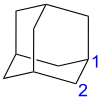
The adamantane molecule is composed of only carbon and hydrogen and has Td symmetry. Therefore, its 16 hydrogen and 10 carbon atoms can exist described by only two sites, which are labeled in the figure as 1 (4 equivalent sites) and 2 (6 equivalent sites).
Structural relatives of adamantane are noradamantane and homoadamantane, which respectively contain i less and one more than CH2 link than the adamantane.
Chemical backdrop [edit]
Adamantane cations [edit]
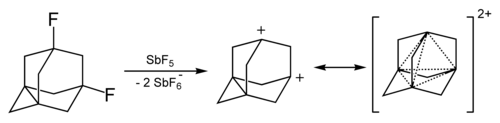
The adamantane cation can be produced by treating ane-fluoro-adamantane with SbF5. Its stability is relatively high.[thirty] [31]
The dication of 1,3-didehydroadamantane was obtained in solutions of superacids. Information technology too has elevated stability due to the miracle called "iii-dimensional aromaticity"[32] or homoaromaticity.[33] This four-middle two-electron bond involves one pair of electrons delocalized amid the four bridgehead atoms.
Reactions [edit]
Most reactions of adamantane occur via the three-coordinated carbon sites. They are involved in the reaction of adamantane with concentrated sulfuric acrid which produces adamantanone.[34]
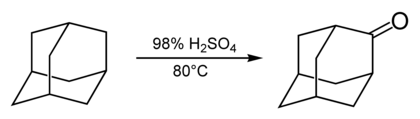
The carbonyl group of adamantanone allows farther reactions via the bridging site. For instance, adamantanone is the starting compound for obtaining such derivatives of adamantane as two-adamantanecarbonitrile[35] and ii-methyl-adamantane.[36]
Bromination [edit]
Adamantane readily reacts with various brominating agents, including molecular bromine. The composition and the ratio of the reaction products depend on the reaction conditions and peculiarly the presence and type of catalysts.[19]
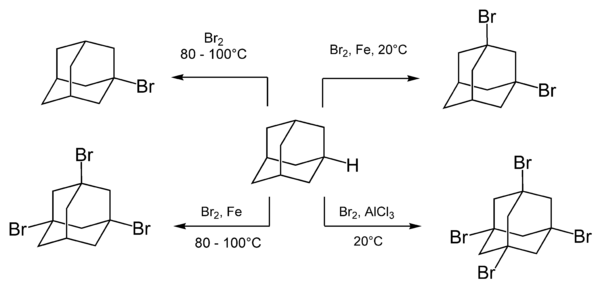
Boiling of adamantane with bromine results in a monosubstituted adamantane, one-bromadamantane. Multiple exchange with bromine is achieved by adding a Lewis acrid catalyst.[37]
The charge per unit of bromination is accelerated upon addition of Lewis acids and is unchanged by irradiation or improver of free radicals. This indicates that the reaction occurs via an ionic mechanism.[8]
Fluorination [edit]
The first fluorinations of adamantane were conducted using 1-hydroxyadamantane[38] and one-aminoadamantane as initial compounds. Later, fluorination was achieved starting from adamantane itself.[39] In all these cases, reaction proceeded via formation of adamantane cation which then interacted with fluorinated nucleophiles. Fluorination of adamantane with gaseous fluorine has also been reported.[forty]
Carboxylation [edit]
Carboxylation of adamantane was first reported in 1960, using formic acid as a carboxylating agent and carbon tetrachloride as a solvent.[41]

tert-butanol (t-BuOH) and sulfuric acrid were added to generate adamantane cation; the cation was then carboxylated by carbon monoxide generated in situ in the interaction between the formic and sulfuric acids.[viii] The fraction of carboxylated adamantane was 55-60%.[42]
Oxidation [edit]
ane-Hydroxyadamantane is readily formed by hydrolysis of 1-bromadamantane in aqueous solution of acetone. It tin likewise be produced by ozonation of the adamantane:[43] Oxidation of the booze gives adamantanone.

Others [edit]
Adamantane interacts with Benzene in the presence of Lewis acids, resulting in a Friedel–Crafts reaction.[44] Aryl-substituted adamantane derivatives can exist hands obtained starting from ane-hydroxyadamantane. In particular, the reaction with anisole proceeds under normal conditions and does not require a catalyst.[37]
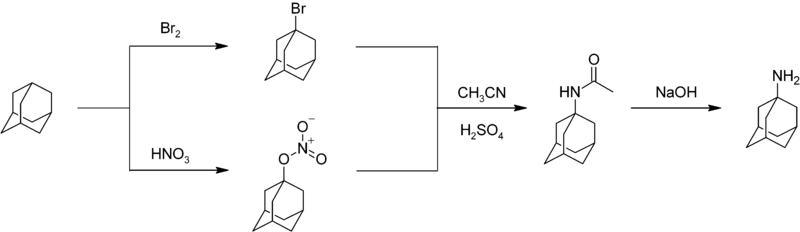
Nitration of adamantane is a hard reaction characterized past moderate yields.[45] A nitrogen-substituted drug amantadine tin be prepared by reacting adamantane with bromine or nitric acid to give the bromide or nitroester at the 1-position. Reaction of either compound with acetonitrile affords the acetamide, which is hydrolyzed to give 1-adamantylamine:[46]
Uses [edit]
Adamantane itself enjoys few applications since information technology is merely an unfunctionalized hydrocarbon. It is used in some dry out carving masks[47] and polymer formulations.
In solid-state NMR spectroscopy, adamantane is a common standard for chemical shift referencing.[48]
In dye lasers, adamantane may be used to extend the life of the gain medium; it cannot be photoionized nether atmosphere because its absorption bands lie in the vacuum-ultraviolet region of the spectrum. Photoionization energies have been adamant for adamantane as well as for several bigger diamondoids.[49]
In medicine [edit]
All medical applications known so far involve not pure adamantane, but its derivatives. The kickoff adamantane derivative used as a drug was amantadine – showtime (1967) as an antiviral drug confronting diverse strains of flu[50] and then to treat Parkinson'south disease.[51] [52] Other drugs amongst adamantane derivatives include adapalene, adapromine, bromantane, carmantadine, chlodantane, dopamantine, memantine, rimantadine, saxagliptin, tromantadine, and vildagliptin. Polymers of adamantane have been patented as antiviral agents against HIV.[53]
Influenza virus strains take developed drug resistance to amantadine and rimantadine, which are not constructive against prevalent strains as of 2016.


In designer drugs [edit]
Adamantane was recently identified as a central structural subunit in several synthetic cannabinoid designer drugs, namely AB-001 and SDB-001.[54]
Spacecraft fuel [edit]
Adamantane is an attractive candidate for fuel in Hall thrusters because it ionizes easily, can be stored in solid form rather than a heavy pressure tank, and is relatively nontoxic. [55]
Potential technological applications [edit]
Some alkyl derivatives of adamantane accept been used as a working fluid in hydraulic systems.[56] Adamantane-based polymers might find awarding for coatings of touchscreens,[57] and at that place are prospects for using adamantane and its homologues in nanotechnology. For instance, the soft muzzle-similar structure of adamantane solid allow incorporation of invitee molecules, which can exist released inside the human being trunk upon breaking the matrix.[xv] [58] Adamantane could be used equally molecular edifice blocks for self-assembly of molecular crystals.[59] [60]
Adamantane analogues [edit]
Many molecules and ions prefer adamantane-like cage structures. Those include phosphorus trioxide P4Ovi, arsenic trioxide Every bitivOhalf-dozen, phosphorus pentoxide P4Ox = (PO)ivO6, phosphorus pentasulfide P4Due southx = (PS)ivShalf-dozen, and hexamethylenetetramine CviNorth4H12 = N4(CH2)six.[61] Specially notorious is tetramethylenedisulfotetramine, often shortened to "tetramine", a rodenticide banned in most countries for extreme toxicity to humans. The silicon counterpart of adamantane, sila-adamantane, was synthesized in 2005.[62] Arsenicin A is a naturally occurring organoarsenic analogue isolated from the New Caledonian marine sponge Echinochalina bargibanti and is the first known polyarsenic organic compound.[63] [64] [65] [66]
-

Adamantane
-

-

-

-

-

-

Conjoining adamantane cages produces higher diamondoids, such equally diamantane (C14H20 – 2 fused adamantane cages), triamantane (CeighteenH24), tetramantane (C22H28), pentamantane (C26H32), hexamantane (C26H30), etc. Their synthesis is similar to that of adamantane and similar adamantane, they can also be extracted from petroleum, though at even much smaller yields.
See also [edit]
- twistane
References [edit]
- ^ a b Nomenclature of Organic Chemistry : IUPAC Recommendations and Preferred Names 2013 (Blue Book). Cambridge: The Purple Society of Chemistry. 2014. p. 169. doi:ten.1039/9781849733069-FP001. ISBN978-0-85404-182-4.
The retained names adamantane and cubane are used in general nomenclature and as preferred IUPAC names.
- ^ a b c d Windsor, C K; Saunderson, D H; Sherwood, J N; Taylor, D; Pawley, M Southward (1978). "Lattice dynamics of adamantane in the disordered phase". Journal of Physics C: Solid State Physics. 11 (9): 1741–1759. Bibcode:1978JPhC...11.1741W. doi:10.1088/0022-3719/11/9/013.
- ^ a b c d Bagrii, Eastward.I. (1989). Adamantanes: synthesis, properties, applications (in Russian). Nauka. pp. 5–57. ISBN5-02-001382-X.
- ^ Alexander Senning. Elsevier'southward Dictionary of Chemoetymology. Elsevier, 2006, p. 6 ISBN 0-444-52239-5.
- ^ Decker H. (1924). "Versammlung deutscher Naturforscher und Ärzte. Innsbruck, 21–27 September 1924". Angew. Chem. 37 (41): 795. Bibcode:1924AngCh..37..781.. doi:10.1002/ange.19240374102.
- ^ Radcliffe, Marc D.; Gutierrez, Alberto; Blount, John F.; Mislow, Kurt (1984). "Structure of Meerwein'southward ester and of its benzene inclusion chemical compound" (PDF). Journal of the American Chemical Guild. 106 (3): 682–687. doi:10.1021/ja00315a037. Archived from the original (PDF) on 2011-08-09. Retrieved 2010-05-26 .
- ^ South. Coffey, Southward. Rodd (ed.) Chemistry of Carbon Compounds. Vol 2. Part C. Elsevier Publishing Co.: New York. 1969
- ^ a b c d e f Fort, Raymond C. Jr.; Schleyers, Paul Von R. (1964). "Adamantane: Consequences of Diamondoid Structure". Chem. Rev. 64 (three): 277–300. doi:10.1021/cr60229a004.
- ^ Prelog 5, Seiwerth R (1941). "Über die Synthese des Adamantans". Berichte. 74 (10): 1644–1648. doi:10.1002/cber.19410741004.
- ^ Prelog V, Seiwerth R (1941). "Über eine neue, ergiebigere Darstellung des Adamantans". Berichte. 74 (eleven): 1769–1772. doi:ten.1002/cber.19410741109.
- ^ Stetter, H., Bander, O., and Neumann, W., Ber., 89, 1922 (1956).
- ^ McKervey, M (1980). "Synthetic approaches to big diamondoid hydrocarbons". Tetrahedron. 36 (8): 971–992. doi:10.1016/0040-4020(lxxx)80050-0.
- ^ Schleyer, P. von R. (1957). "A Unproblematic Preparation of Adamantane". J. Am. Chem. Soc. 79 (12): 3292. doi:10.1021/ja01569a086.
- ^ Schleyer, P. von R.; Donaldson, M. M.; Nicholas, R. D.; Cupas, C. (1973). "Adamantane". Organic Syntheses. ; Collective Volume, vol. v, p. 16
- ^ a b Mansoori, Thou. Ali (2007). Molecular building blocks for nanotechnology: from diamondoids to nanoscale materials and applications. Springer. pp. 48–55. ISBN978-0-387-39937-nine.
- ^ a b c Drabble, J R; Husain, A H M (1980). "Elastic properties of adamantane unmarried crystals". Periodical of Physics C: Solid State Physics. 13 (8): 1377–1380. Bibcode:1980JPhC...13.1377D. doi:10.1088/0022-3719/13/viii/008.
- ^ Landa, S.; Machácek, V. (1933). "Sur l'adamantane, nouvel hydrocarbure extrait de naphte". Collection of Czechoslovak Chemical Communications. 5: 1–5. doi:10.1135/cccc19330001.
- ^ Landa, Due south.; Machacek, V.; Mzourek, M.; Landa, M. (1933), "Title unknown", Chim Ind. Spec. Publ. Vol. 506 (Abstracts of the twelfth Conference of Industrial Chemistry, Prague, Sept. 1932); Chem. Abstr. 1933. Vol. 27. P. 5949.
- ^ a b c "Synthesis of adamantane" (in Russian). Retrieved 2009-12-eleven . Special applied trouble for the students of 4 yr. Department of Petroleum Chemical science and Organic Catalysis MSU.
- ^ a b Bagriy EI (1989). "Methods for hydrocarbon adamantane series". Adamantane: Synthesis, backdrop, application. Moscow: Nauka. pp. 58–123. ISBN5-02-001382-10.
- ^ "Adamantane". Encyclopedia of Chemistry (in Russian). Retrieved 2009-12-eleven .
- ^ a b Vijayakumar, V.; et al. (2001). "Force per unit area induced stage transitions and equation of country of adamantane". J. Phys.: Condens. Matter. thirteen (9): 1961–1972. Bibcode:2001JPCM...13.1961V. doi:10.1088/0953-8984/thirteen/9/318.
- ^ Anastassakis, E.; Siakavellas, Chiliad. (1999). "Elastic and Lattice Dynamical Properties of Textured Diamond Films". Physica Condition Solidi B. 215 (one): 189–192. Bibcode:1999PSSBR.215..189A. doi:10.1002/(SICI)1521-3951(199909)215:1<189::Aid-PSSB189>3.0.CO;2-X.
- ^ Mansoori, 1000. Ali (2005). Principles of nanotechnology: molecular-based report of condensed matter in modest systems . World Scientific. p. 12. ISBN981-256-154-four.
- ^ Wright, John Dalton (1995). Molecular crystals. Cambridge University Press. p. 28. ISBN0-521-47730-1.
- ^ a b NMR, IR and mass spectra of adamantane can be found in the SDBS database
- ^ March, J. (1987). Organic chemical science. Reactions, mechanisms, construction. Advanced class for universities and higher pedagogy chemical. Vol. 1. Chiliad.: World. p. 137.
- ^ Applequist, J.; Rivers, P.; Applequist, D. Eastward. (1969). "Theoretical and experimental studies of optically active bridgehead-substituted adamantanes and related compounds". J. Am. Chem. Soc. 91 (21): 5705–5711. doi:10.1021/ja01049a002.
- ^ Hamill, H.; McKervey, G. A. (1969). "The resolution of iii-methyl-5-bromoadamantanecarboxylic acid". Chem. Comm. (fifteen): 864. doi:10.1039/C2969000864a.
- ^ Schleyer P. R.; Fort R. C.; Watts W. E. (1964). "Stable Carbonium Ions. 8. The 1-Adamantyl Cation". J. Am. Chem. Soc. 86 (19): 4195–4197. doi:10.1021/ja01073a058.
- ^ Olah, George A.; Prakash, Thou. K. Surya; Shih, Joseph G.; Krishnamurthy, V. Five.; Mateescu, Gheorge D.; Liang, Gao; Sipos, Gyorgy; Buss, Volker; Gund, Tamara M.; Schleyer, Paul v. R. (1985). "Bridgehead adamantyl, diamantyl, and related cations and dications". J. Am. Chem. Soc. 107 (nine): 2764–2772. doi:10.1021/ja00295a032.
- ^ Smith, W.; Bochkov A.; Caple, R. (2001). Organic Synthesis. Science and art. Chiliad.: World. p. 573. ISBN5-03-003380-7.
- ^ Bremer, Matthias; von Ragué Schleyer, Paul; Schötz, Karl; Kausch, Michael; Schindler, Michael (1987). "Four-Middle Two-Electron Bonding in a Tetrahedral Topology. Experimental Realization of Iii-Dimensional Homoaromaticity in the 1,iii-Dehydro-5,seven-adamantanediyl Dication". Angewandte Chemie International Edition in English. 26 (8): 761–763. doi:10.1002/anie.198707611.
- ^ Geluk, H. West.; Keizer, 5. G. (1973). "Adamantanone". Organic Syntheses. 53: viii. doi:10.15227/orgsyn.053.0008.
- ^ ii-Adamantanecarbonitrile Archived 2012-07-10 at the Wayback Machine Organic Syntheses, Coll. Vol. 6, p. 41 (1988); Vol. 57, p. 8 (1977).
- ^ Schleyer P. R.; Nicholas R. D. (1961). "The Grooming and Reactivity of 2-Substituted Derivatives of Adamantane". J. Am. Chem. Soc. 83 (1): 182–187. doi:x.1021/ja01462a036.
- ^ a b Nesmeyanov, A. N. (1969). Bones organic chemistry (in Russian). p. 664.
- ^ Olah, George A.; Welch, John T.; Vankar, Yashwant D.; Nojima, Mosatomo; Kerekes, Istvan; Olah, Judith A. (1979). "Pyridinium poly (hydrogen fluoride): a user-friendly reagent for organic fluorination reactions". Journal of Organic Chemical science. 44 (22): 3872–3881. doi:ten.1021/jo01336a027.
- ^ Olah, George A.; Shih, Joseph G.; Singh, Brij P.; Gupta, B. G. B. (1983). "Ionic fluorination of adamantane, diamantane, and triphenylmethane with nitrosyl tetrafluoroborate/pyridine polyhydrogen fluoride (PPHF)". Journal of Organic Chemistry. 48 (19): 3356–3358. doi:10.1021/jo00167a050.
- ^ Rozen, Shlomo.; Gal, Chava (1988). "Direct synthesis of fluoro-bicyclic compounds with fluorine". Journal of Organic Chemistry. 53 (12): 2803–2807. doi:10.1021/jo00247a026.
- ^ Koch, H.; Haaf, W. (1960). "Direkte Synthese der Adamantan-carbonsäure-(ane)". Angewandte Chemie. 72 (17): 628. Bibcode:1960AngCh..72..628K. doi:10.1002/ange.19600721710.
- ^ 1-Adamantanecarboxylic acrid Organic Syntheses, Coll. Vol. 5, p. twenty (1973); Vol. 44, p. 1 (1964).
- ^ Zvi Cohen, Haim Varkony, Ehud Keinan, and Yehuda Mazur 3rd alcohols from hydrocarbons past ozonation on silica gel: 1-adamantanol Organic Syntheses, Coll. Vol. six, p. 43 (1988); Vol. 59, p. 176 (1979)
- ^ Chalais, Stephane; Corn lis, Andr; Gerstmans, Andr; Ko?odziejski, Wac?aw; Laszlo, Pierre; Mathy, Arthur; Thousand tra, Pierre (1985). "Direct clay-catalyzed Friedel-Crafts arylation and chlorination of the hydrocarbon adamantane". Helvetica Chimica Acta. 68 (5): 1196–1203. doi:10.1002/hlca.19850680516.
- ^ Smith, George Due west.; Williams, Harry D. (1961). "Some Reactions of Adamantane and Adamantane Derivatives". J. Org. Chem. 26 (vii): 2207–2212. doi:10.1021/jo01351a011.
- ^ Moiseev, I. K.; Doroshenko, R. I.; Ivanova, Five. I. (1976). "Synthesis of amantadine via the nitrate of 1-adamantanol". Pharmaceutical Chemistry Journal. ten (4): 450–451. doi:10.1007/BF00757832. S2CID 26161105.
- ^ Watanabe, Keiji; et al. (2001). "Resist Limerick and Design Forming Procedure". United States Patent Application 20010006752. Bandwidth Market place, Ltd. Archived from the original on September iv, 2011. Retrieved 14 October 2005.
- ^ Morcombe, Corey R.; Zilm, Kurt W. (2003). "Chemical Shift referencing in MAS solid state NMR". J. Magn. Reson. 162 (2): 479–486. Bibcode:2003JMagR.162..479M. doi:ten.1016/S1090-7807(03)00082-X. PMID 12810033.
- ^ Lenzke, K.; Landt, L.; Hoener, G.; et al. (2007). "Experimental determination of the ionization potentials of the get-go v members of the nanodiamond serial". J. Chem. Phys. 127 (viii): 084320. Bibcode:2007JChPh.127h4320L. doi:ten.1063/1.2773725. PMID 17764261. S2CID 3131583.
- ^ Maugh, T. (1979). "Panel urges wide utilize of antiviral drug". Scientific discipline. 206 (4422): 1058–60. Bibcode:1979Sci...206.1058M. doi:ten.1126/science.386515. PMID 386515.
- ^ Sonnberg, Lynn (2003). The Complete Pill Guide: Everything You Demand to Know near Generic and Brand-Proper noun Prescription Drugs. Barnes & Noble Publishing. p. 87. ISBN0-7607-4208-i.
- ^ Blanpied TA, Clarke RJ, Johnson JW (2005). "Amantadine inhibits NMDA receptors past accelerating channel closure during aqueduct block". Journal of Neuroscience. 25 (13): 3312–22. doi:10.1523/JNEUROSCI.4262-04.2005. PMC6724906. PMID 15800186.
- ^ Boukrinskaia, A. G.; et al. "Polymeric Adamantane Analogues" (U.Southward. Patent five,880,154) . Retrieved 2009-eleven-05 .
- ^ Banister, Southward. D.; Wilkinson, S. Yard.; Longworth, Thousand.; Stuart, J.; Apetz, Northward.; English, One thousand.; Brooker, L.; Goebel, C.; Hibbs, D. Due east.; Glass, Thousand.; Connor, M.; McGregor, I. S.; Kassiou, Thou. (2013). "The synthesis and pharmacological evaluation of adamantane-derived indoles: Novel cannabimimetic drugs of corruption". ACS Chemical Neuroscience. 4 (vii): 1081–92. doi:10.1021/cn400035r. PMC3715837. PMID 23551277.
- ^ "AIS-EHT1 Micro End Hall Thruster - Applied Ion Systems". Retrieved 2021-02-22 .
- ^ "Adamantane". Krugosvet (in Russian). Archived from the original on 6 November 2009. Retrieved 2009-11-11 .
- ^ Jeong, H. Y. (2002). "Synthesis and characterization of the showtime adamantane-based poly (p-phenylenevinylene) derivative: an intelligent plastic for smart electronic displays". Thin Solid Films. 417 (ane–2): 171–174. Bibcode:2002TSF...417..171J. doi:10.1016/S0040-6090(02)00569-ii.
- ^ Ramezani, Hamid; Mansoori, Thou. Ali (2007). Diamondoids as Molecular Building Blocks for Nanotechnology. Topics in Practical Physics. Vol. 109. pp. 44–71. doi:ten.1007/978-0-387-39938-6_4. ISBN978-0-387-39937-9.
- ^ Markle, R. C. (2000). "Molecular building blocks and development strategies for molecular nanotechnology". Nanotechnology. 11 (2): 89–99. Bibcode:2000Nanot..xi...89M. doi:ten.1088/0957-4484/11/2/309.
- ^ Garcia, J. C.; Justo, J. F.; Machado, Westward. Five. M.; Assali, 50. V. C. (2009). "Functionalized adamantane: building blocks for nanostructure self-assembly". Phys. Rev. B. 80 (12): 125421. arXiv:1204.2884. Bibcode:2009PhRvB..80l5421G. doi:x.1103/PhysRevB.80.125421. S2CID 118828310.
- ^ Vitall, J. J. (1996). "The Chemistry of Inorganic and Organometallic Compounds with Adamantane-Like Structures". Polyhedron. xv (10): 1585–1642. doi:10.1016/0277-5387(95)00340-1.
- ^ Fischer, Jelena; Baumgartner, Judith; Marschner, Christoph (2005). "Synthesis and Structure of Sila-Adamantane". Science. 310 (5749): 825. doi:x.1126/scientific discipline.1118981. PMID 16272116. S2CID 23192033.
- ^ Mancini, Ines; Guella, Graziano; Frostin, Maryvonne; Hnawia, Edouard; Laurent, Dominique; Debitus, Cecile; Pietra, Francesco (2006). "On the Offset Polyarsenic Organic Compound from Nature: Arsenicin a from the New Caledonian Marine Sponge Echinochalina bargibanti". Chemical science: A European Journal. 12 (35): 8989–94. doi:10.1002/chem.200600783. PMID 17039560.
- ^ Tähtinen, Petri; Saielli, Giacomo; Guella, Graziano; Mancini, Ines; Bagno, Alessandro (2008). "Computational NMR Spectroscopy of Organoarsenicals and the Natural Polyarsenic Compound Arsenicin A". Chemical science: A European Journal. 14 (33): 10445–52. doi:10.1002/chem.200801272. PMID 18846604.
- ^ Guella, Graziano; Mancini, Ines; Mariotto, Gino; Rossi, Barbara; Viliani, Gabriele (2009). "Vibrational analysis as a powerful tool in structure elucidation of polyarsenicals: a DFT-based investigation of arsenicin A". Physical Chemistry Chemical Physics. 11 (xiv): 2420–2427. Bibcode:2009PCCP...xi.2420G. doi:10.1039/b816729j. PMID 19325974.
- ^ Di Lu; A. David Rae; Geoff Salem; Michelle 50. Weir; Anthony C. Willis; South. Bruce Wild (2010). "Arsenicin A, A Natural Polyarsenical: Synthesis and Crystal Structure". Organometallics. 29 (i): 32–33. doi:x.1021/om900998q. hdl:1885/58485.

How To Draw Adamantane In Chemdraw,
Source: https://en.wikipedia.org/wiki/Adamantane
Posted by: spraguewithery.blogspot.com
0 Response to "How To Draw Adamantane In Chemdraw"
Post a Comment