

How To Draw A Red Box In A Table Latex
Tabular array of contents
Boxes
A single – line box can be created using the command \text or \makebox and a multi – line command can be created using the command \parbox or a minipage environs. At that place are many types of boxes and some of them are discussed below:
1. Line boxes
The control \text creates a line box that creates a line box and is used to typeset the argument without breaking lines and is taken equally a unmarried graphic symbol. This makes the argument extend into the margin. For case, the command \text{speaker} treats the seven characters of the word every bit one. It allows the user to use this phrase in the argument in a formula and prevents The command \mbox is the short form of \makebox. This argument besides prevents from breaking an statement but keeps the size of the subscript and superscript aforementioned. The full command is written as \makebox[width][alignment]{text} where, The optional width argument, width, tin use four length commands: \height is used to give the height of the box higher up baseline, \depth gives the depth of the box below baseline, \totalheight is the sum of \height and \depth and \width is used to decide the width of the box.
\documentclass{article} \usepackage[utf8]{inputenc} \begin{document} \makebox{Text Box.}End\\ \makebox[2in][fifty]{Text Box.}End\\ \makebox[2in]{Text Box.}End\\ \makebox[2in][r]{Text Box.}End\\ \makebox[2in][due south]{Text Box.}End \cease{document} 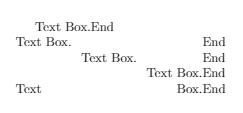
-
Width is an optional command that gives the width of the box and if omitted, the box is as wide as necessary co-ordinate to the contents. It can be specified in inches.
-
Alignment is an optional command. The is placed at the center by default, l sets it to affluent left, r sets it to flush right and due south stretches the length to the total length of the box if it has blank spaces.
-
Text is the text within the box.
The command \rlap is a variant of the \makebox command whose functionality is to make a box and pretend that it has nada width.
ii. Frame Boxes
The control \fbox or \framebox generates the frame boxes. This command is used for a single line box as the boxes cannot be broken, hence for a box having more than ane line we should use the command \parabox or the minipage environment.
\documentclass{article} \usepackage[utf8]{inputenc} \begin{document} \framebox[1.one\width]{This fits inside the frame} \par \framebox[0.eight\width][r]{This is likewise wide for the frame} \par \framebox[1cm][50]{This does not fit at all} \terminate{document} Output of the above lawmaking
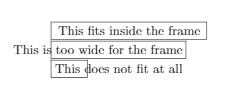
This control works exactly similar the \makebox control except, that it makes the frame around the box.
3. Paragraph Boxes
A paragraph box is particularly used when the user is working within a tabular surround. Information technology works like a paragraph whose width is given by the user. The command \parbox typesets the content which is given in its second statement and its first statement gives the width of the box. The box that is generated is handled as a single character
\documentclass{commodity} \usepackage[utf8]{inputenc} \begin{certificate} \parbox{\textwidth}{ Some very long text\\ that would not be allowed\\ in a frame box.} \stop{certificate} Output of the above code
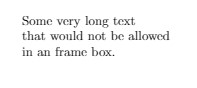
The command \parbox creates a grapheme that is placed on the line so that its vertical center is aligned with the center of the line. The total syntax of the command is \parbox[alignment][height][[inner-alignment]{width}{text}. The inner alignment is the vertical equivalent of the alignment of the \makebox control. It determines the position of the text. When the inner alignment argument is non given, and then information technology is taken as an alignment.
4. Solid Boxes
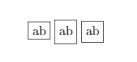
A solid box is generated using the command \dominion. The first argument gives the width and the 2d statement is for the height. The positioning of the symbol is washed using the first optional argument. Solid boxes having zippo width are known equally struts. Standard struts can be added using the command \strut or \mathstrut .
\documentclass{article} \usepackage[utf8]{inputenc} \begin{document} \fbox{ab} \fbox{\strut ab} \fbox{$\mathstrut$ab} \end{certificate} Output of the above code
5. Fine Tuning Boxes
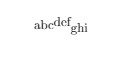
The command \raisebox {displacement}{text} typesets text in a box with a vertical displacement. If displacement is positive and so the box is raised, otherwise the box is lowered.
\documentclass{commodity} \usepackage[utf8]{inputenc} \brainstorm{document} abc\raisebox{.5ex}{def}\raisebox{-.5ex}{ghi} \terminate{certificate} Output of the in a higher place code

How To Draw A Red Box In A Table Latex,
Source: https://www.docx2latex.com/tutorials/boxes-comments-LaTeX.html/
Posted by: spraguewithery.blogspot.com
0 Response to "How To Draw A Red Box In A Table Latex"
Post a Comment